
Introduction to the Eiercode Archetypal Applications
The earliest documentation of the Eiercode appears in the 1771 journals of Yaakov “Calf” Gamhain, written during his time in Leicester. In these entries, he recorded that he had been “given” the Code during an event he later referred to as The Happening. The journals once included a more detailed account of this moment, along with early proofs and diagrams, but these materials were later misplaced. What survives suggests that the event was singular in nature and marked the beginning of his work with the Code.
In the period following The Happening, Gamhain described what he believed to be his first experience of temporal displacement created through the structural mechanisms of the Code. This shift allowed him to observe consistent geometric formations within the emotional temporal lattice. He recorded these as recurring arrangements of curvature, vector alignment, and void distribution that appeared across individuals who shared no common history or cultural environment.
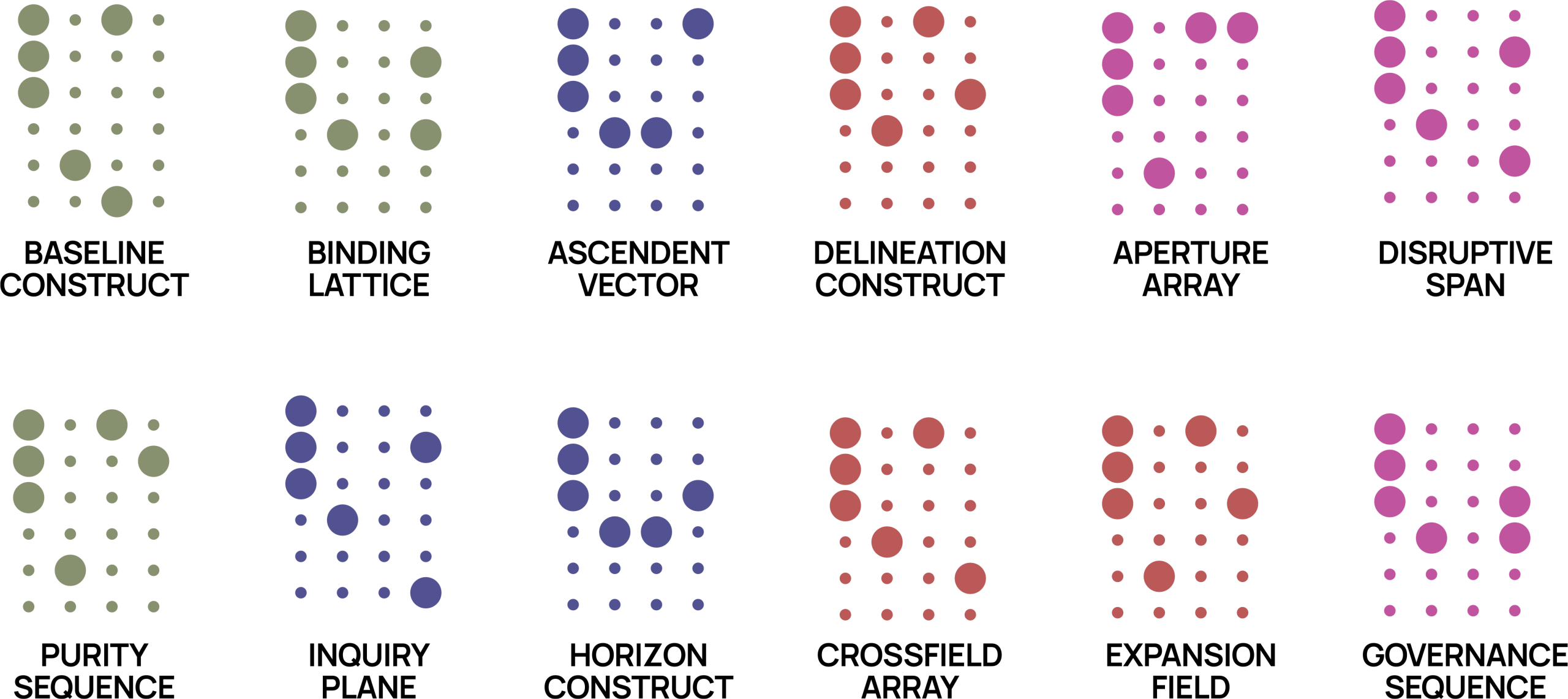
When mapped across the complete corpus of 134,596 kartens, these formations resolve into twelve stable structures he termed the Clutch. Each Clutch arises from specific interactions among the Four Foundational Conditions. Emotion determines curvature, time establishes operational span, matter anchors internal structure, and void defines functional limits.
The applications in this section represent the earliest known uses of each Clutch. Gamhain identified them soon after his initial temporal experience and treated them as structural configurations rather than interpretive identities. For clarity, the Jungian archetypes are referenced only as familiar parallels for modern readers, although the Eiercode Clutch predates analytical psychology by more than a century and originates from geometric rather than symbolic principles.
These twelve applications form the first operational framework through which behavior and perception can be understood using the geometry imparted to Gamhain during The Happening, the documentation of which remains misplaced.