

Eiercode Archetypal Applications

Introduction to the Eiercode Archetypal Applications

The earliest documentation of the Eiercode appears in the 1771 journals of Yaakov “Calf” Gamhain, written during his time in Leicester. In these entries, he recorded that he had been “given” the Code during an event he later referred to as The Happening. The journals once included a more detailed account of this moment, along with early proofs and diagrams, but these materials were later misplaced. What survives suggests that the event was singular in nature and marked the beginning of his work with the Code.

In the period following The Happening, Gamhain described what he believed to be his first experience of temporal displacement created through the structural mechanisms of the Code. This shift allowed him to observe consistent geometric formations within the emotional temporal lattice. He recorded these as recurring arrangements of curvature, vector alignment, and void distribution that appeared across individuals who shared no common history or cultural environment.

When mapped across the complete corpus of 134,596 kartens, these formations resolve into twelve stable structures he termed the Clutch. Each Clutch arises from specific interactions among the Four Foundational Conditions. Emotion determines curvature, time establishes operational span, matter anchors internal structure, and void defines functional limits.

The applications in this section represent the earliest known uses of each Clutch. Gamhain identified them soon after his initial temporal experience and treated them as structural configurations rather than interpretive identities. For clarity, the Jungian archetypes are referenced only as familiar parallels for modern readers, although the Eiercode Clutch predates analytical psychology by more than a century and originates from geometric rather than symbolic principles.

These twelve applications form the first operational framework through which behavior and perception can be understood using the geometry imparted to Gamhain during The Happening, the documentation of which remains misplaced.
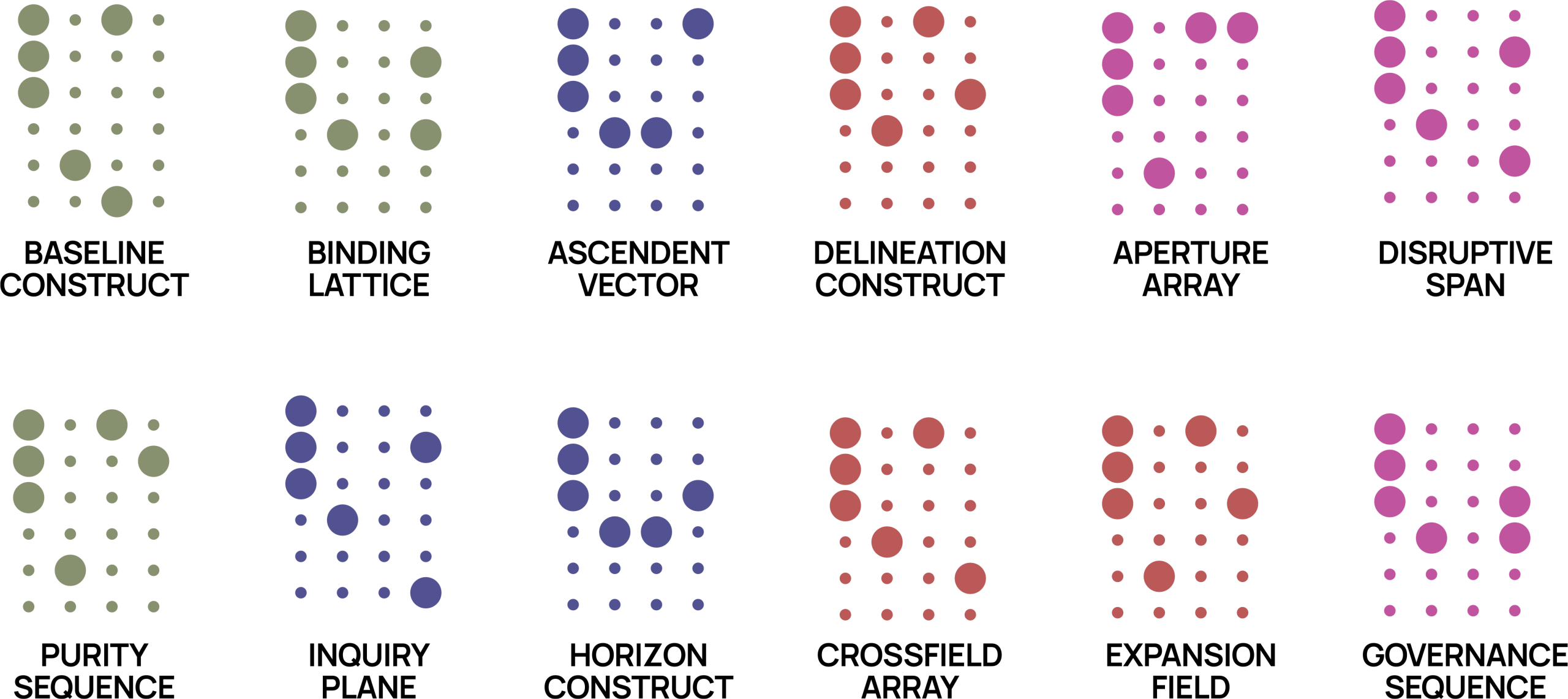
Clutches within The Gamhain Eiercode
The Twelve Clutches can be understood through their alignment with the Four Foundational Conditions. Each Clutch expresses a dominant field behavior that determines its primary role within the lattice. The Baseline Construct, Binding Lattice, and Purity Sequence belong to Emotion, defined by curvature, resonance, and relational coherence. The Ascendant Vector, Inquiry Plane, and Horizon Construct align with Time through momentum, dispersion, and extended temporal reach. The Delineation Construct, Crossfield Array, and Expansion Field correspond to Matter, emphasizing anchoring and structural distribution. The Aperture Array, Disruptive Span, and Governance Sequence fall under Void, where absence, volatility, and dissolution shape their geometry.

EMOTION-DOMINANT CLUTCHES

Emotion governs curvature generation, resonance amplitude, and affective coherence.

The Baseline Construct

The Everyman

Structural Definition
A low curvature formation with broad void boundaries and balanced temporal distribution.

Light Application: Coherence Stabilization
Practitioners engage with Houses whose kartens show minimal curvature and wide void boundaries. This re establishes baseline coherence, reducing internal turbulence and restoring linear temporal perception.

Dark Application: Regression Collapse
Excessive use collapses temporal density into oversimplified states. Emotional curvature flattens, producing functional passivity and reduced adaptive capacity.

The Binding Lattice

The Lover

Structural Definition
A connective geometry binding multiple emotional vectors into a unified field.

Light Application: Relational Integration
Strengthens inter system coherence by synchronizing emotional resonance across linked Houses.

Dark Application: Overbinding Collapse
Cross linking beyond threshold limits reduces independent vector integrity and induces emotional entanglement.

The Purity Sequence

The Innocent

Structural Definition
A simple and symmetrical geometry with balanced void curvature.

Light Application: Receptive Clarity
Allows unfiltered perception of emergent signals within the lattice and promotes adaptive openness.

Dark Application: Vulnerability Spread
Insufficient anchoring enables external distortions to enter the field without resistance.

TIME-DOMINANT CLUTCHES

Time governs vector thrust, temporal scanning, and continuity.

The Ascendant Vector

The Hero

Structural Definition
A rising field pattern with compressed temporal thrust and narrow void channels.

Light Application: Directed Advancement
Supports sustained progress by concentrating time vectors toward a single trajectory, increasing resilience during high strain intervals.

Dark Application: Overload Rupture
Concentration of thrust can exceed matter anchors. This produces structural blowout and emotional exhaustion.

The Inquiry Plane

The Sage

Structural Definition
A high dispersion field with broad temporal scanning and low matter anchoring.

Light Application: Pattern Illumination
Enhances perception and multiscalar analysis through increased observational bandwidth.

Dark Application: Dissociative Drift
Prolonged dispersion weakens anchoring, causing detachment and recursive analysis loops.

The Horizon Construct

The Explorer

Structural Definition
A vector outward geometry with extended temporal reach beyond local boundaries.

Light Application: Field Expansion
Supports exploration of new emotional topographies and distant temporal coordinates.

Dark Application: Boundary Dissolution
Overextension degrades structural containment and destabilizes proximal Houses.

MATTER-DOMINANT CLUTCHES

Matter governs anchoring, resistance, structural boundaries, and load distribution.

The Delineation Construct

The Ruler

Structural Definition
A tightly organized matter anchored geometry with minimal void fluctuation.

Light Application: Boundary Formation
Creates strong structural boundaries that enable predictable outcomes and coherent field operations.

Dark Application: Constraint Saturation
Over reliance raises internal resistance, generating rigidity that destabilizes adjacent fields.

The Crossfield Array

The Magician

Structural Definition
An intersecting structure where time and matter vectors produce controlled distortive interference.

Light Application: Field Transformation
Allows recalibration of internal vectors and converts high strain conditions into functional structures.

Dark Application: Overconversion Failure
Misalignment amplifies distortive interference and fractures the geometry.

The Expansion Field

The Caregiver

Structural Definition
A wide curvature distribution with diffused temporal pathways.

Light Application: Supportive Distribution
Stabilizes collective systems by distributing emotional bandwidth across adjacent Houses.

Dark Application: Energetic Drain
Diffusion across too many vectors depletes internal reserves and causes structural thinning.

VOID-DOMINANT CLUTCHES

Void governs exclusion zones, destabilization, and the collapse of structure.

The Aperture Array

The Creator

Structural Definition
A formation marked by expanded void lattices that permit new vector alignments.

Light Application: Emergent Pathway Formation
Opens novel emotional and temporal routes, allowing new configurations to appear within the lattice.

Dark Application: Structural Fragmentation
Large void expansion without anchor reinforcement leads to fragmentation and loss of coherence.

The Disruptive Span

The Outlaw

Structural Definition
An asymmetric geometry with volatile curvature and irregular temporal gradients.

Light Application: Pattern Break
Interrupts stagnant or repetitive structures, enabling recalibration of the lattice.

Dark Application: Instability Propagation
Unregulated disruption creates broad field instability and unpredictable temporal outcomes.

The Governance Sequence

The Jester

Structural Definition
A pattern defined by irregular oscillations that allow rapid modulation of emotional curvature.

Light Application: Adaptive Reorientation
Introduces controlled instability to reset rigid patterns and promote flexibility.

Dark Application: Chaotic Drift
Excessive oscillation removes structural predictability and disrupts temporal continuity.